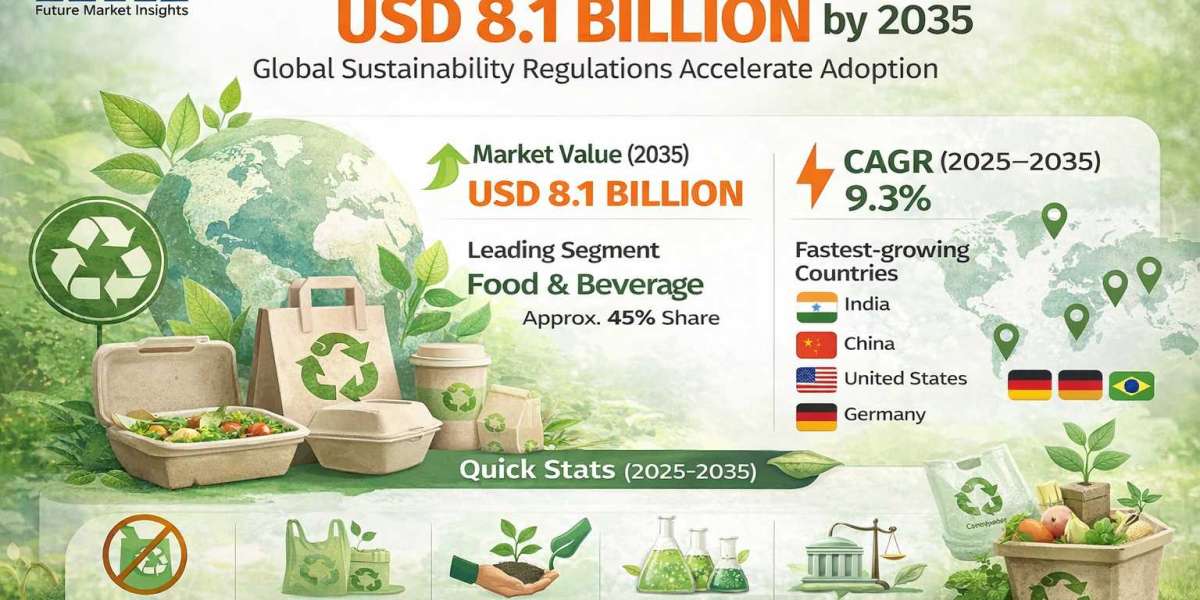

The global compostable packaging market is gaining significant momentum as governments, businesses, and consumers shift toward environmentally responsible packaging solutions. The market is projected to reach USD 8.1 billion by 2035, expanding at a CAGR of 9.3% between 2025 and 2035. This growth is largely driven by increasing restrictions on single-use plastics, growing consumer awareness regarding sustainable packaging, and rapid innovation in biopolymer materials.
Compostable packaging is designed to break down into organic matter under composting conditions without leaving harmful residues. Industries such as food beverages, healthcare, and e-commerce are rapidly adopting compostable materials to align with sustainability commitments and regulatory requirements. Major manufacturers are investing in advanced bioplastic materials and scalable production technologies to develop packaging solutions that maintain product performance while minimizing environmental impact.
Quick Stats: Compostable Packaging Market (2025–2035)
- Market Value (2025): USD 3.3 Billion (Estimated)
• Forecast Value (2035): USD 8.1 Billion
• CAGR: 9.3%
• Leading Segment: Food Beverage End-Use (Approx. 45% Share)
• Key Product Segment: Bioplastic-Based Packaging (Approx. 38% Share)
• Fastest-Growing Countries: India, China, United States, Germany, Brazil
• Key Growth Driver: Global bans on single-use plastic packaging
Structural Growth Driver: Global Regulatory Push for Sustainable Packaging
Government regulations and corporate sustainability commitments are the primary structural drivers of the compostable packaging market. Increasing global concern regarding plastic waste and microplastic pollution has prompted policymakers to introduce strict regulations limiting the use of conventional plastic packaging.
Many countries have introduced plastic bans, extended producer responsibility policies, and waste reduction regulations, encouraging manufacturers to adopt compostable alternatives. In response, companies across industries are transitioning toward compostable materials to ensure regulatory compliance and demonstrate environmental accountability.
Corporate sustainability strategies are also accelerating adoption. Large consumer brands are committing to net-zero emissions and circular economy goals, pushing packaging suppliers to develop compostable materials that can integrate into existing waste management and composting systems.
Key regulatory and industry frameworks include:
- Single-use plastic bans and restrictions
• Compostability certification standards
• Circular economy and waste reduction policies
• Sustainable material guidelines for packaging
From Compliance to Industry Transformation
The compostable packaging market is evolving from a regulatory compliance requirement into a broader industry transformation focused on sustainable material innovation. Packaging manufacturers are redesigning product formats and supply chains to incorporate biodegradable and compostable materials across multiple industries.
Companies are increasingly collaborating with retailers, food brands, and logistics providers to develop compostable packaging solutions that meet both environmental and performance standards. These collaborations help improve product functionality while ensuring compatibility with composting systems and recycling infrastructure.
As consumer demand for eco-friendly products grows, compostable packaging is also becoming a strategic branding tool for businesses seeking to differentiate themselves in competitive markets.
Key priorities shaping industry transformation include:
- Sustainability performance and environmental compliance
• Cost-efficient compostable material development
• Recyclability and compostability integration
• Operational compatibility with existing packaging systems
• Brand differentiation through eco-friendly packaging
Technology Transformation: Biopolymer and Compostable Material Innovation
Technological innovation in biopolymers and plant-based plastics is transforming the compostable packaging industry. Materials such as polylactic acid (PLA), polyhydroxyalkanoates (PHA), and starch-based bioplastics are being developed to provide durability and barrier properties comparable to traditional plastics.
Researchers and manufacturers are also focusing on improving moisture resistance, oxygen barriers, and shelf-life performance to expand the use of compostable packaging in food and healthcare applications. Additionally, innovations in processing technologies are enabling compostable materials to be integrated into existing packaging production lines.
Key innovation areas include:
- Advanced bioplastic material development
• Compostable film and flexible packaging engineering
• Lightweight biodegradable packaging structures
• Sustainable material engineering using renewable resources
• Manufacturing efficiency improvements
Segment Highlights
By Material Type
- Bioplastic-Based Packaging (38% share): Includes PLA, PHA, and starch-based materials widely used in food packaging.
• Paper-Based Compostable Packaging (30% share): Increasingly adopted due to high recyclability and compostability.
• Plant Fiber Packaging: Used for molded packaging applications in foodservice and consumer goods.
• Hybrid Compostable Materials: Combine compostable polymers with natural fibers for enhanced performance.
By End-Use Industry
- Food Beverage (45% share): Dominates demand due to disposable packaging, food wraps, and containers.
• Healthcare: Used for packaging medical products and hygiene materials.
• E-Commerce: Growing adoption of compostable mailers and protective packaging.
• Retail Consumer Goods: Increasing use for sustainable product packaging.
• Foodservice Industry: Widely used in takeaway packaging and disposable utensils.
Regional Outlook: Emerging Economies Drive Adoption
Global adoption of compostable packaging varies significantly by region depending on regulatory frameworks, infrastructure availability, and consumer awareness. North America and Europe currently dominate the market due to strong environmental policies and established composting infrastructure.
Meanwhile, Asia-Pacific is emerging as a high-growth region due to increasing plastic bans, expanding food delivery industries, and government initiatives supporting sustainable materials.
Country growth projections include:
- India (10.2% CAGR): Rapid adoption driven by national plastic reduction policies.
• China (9.8% CAGR): Government initiatives promoting biodegradable packaging.
• United States (8.9% CAGR): Strong demand from foodservice and retail industries.
• Germany (8.5% CAGR): Leadership in sustainable packaging innovation.
• Brazil (8.7% CAGR): Expanding demand in food and beverage sectors.
Risk Landscape: Market Constraints and Challenges
Despite strong growth potential, the compostable packaging market faces several structural challenges related to production costs, infrastructure availability, and consumer awareness.
Key challenges include:
- High manufacturing costs compared to conventional plastics
• Limited industrial composting infrastructure
• Supply chain challenges for biopolymer materials
• Regulatory variations across countries
• Consumer misunderstanding of compostability standards
Competitive Landscape: Key Market Players
The compostable packaging market is moderately competitive, with global chemical companies and packaging manufacturers investing heavily in biopolymer development and sustainable packaging innovation. Leading companies are expanding product portfolios and forming partnerships with consumer brands to scale compostable packaging adoption.
Top key companies include:
- TIPA
• Amcor
• BASF
• Mondi Group
• Novamont
Other notable companies include Futamura Group, NatureWorks LLC, Stora Enso, Danimer Scientific, and Biome Bioplastics.
Outlook: Future of the Compostable Packaging Market
The compostable packaging market is expected to play a critical role in the global transition toward sustainable packaging and circular economy models. As governments introduce stricter environmental regulations and consumers demand eco-friendly products, compostable materials will become increasingly integrated into packaging supply chains.
Future growth drivers include:
- Technology advancement in biodegradable materials
• Sustainability initiatives and circular economy adoption
• Manufacturing expansion in emerging markets
• Supply chain innovation in composting infrastructure
For an in-depth analysis of evolving industry trends and to access the complete strategic outlook for the market through 2035, visit the official report page at: https://www.futuremarketinsights.com/reports/compostable-packaging-market-share-analysis