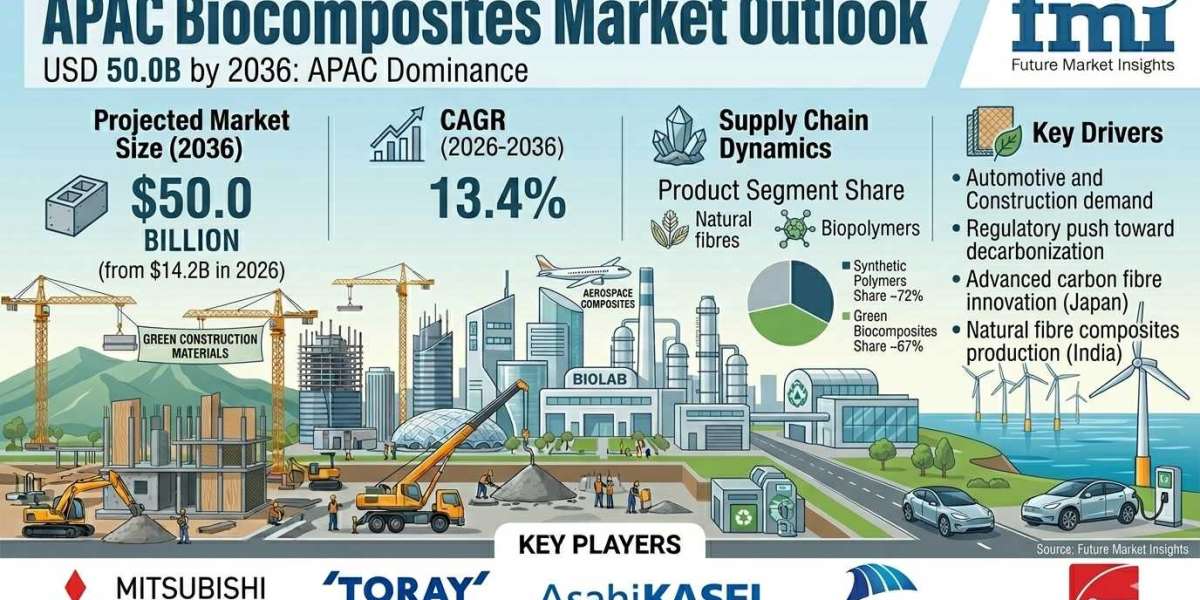

The APAC biocomposites market is entering a high-growth phase, projected to expand from USD 14.2 billion in 2026 to USD 50.0 billion by 2036 at a CAGR of 13.4%. Growth is fueled by rising demand for sustainable materials across automotive, construction, and packaging sectors, alongside strong regulatory push toward decarbonization. Government-backed initiatives and industrial investments are accelerating the transition toward bio-based polymers and natural fibre composites.
Japan is strengthening its position through advanced carbon fibre innovation and policy-backed decarbonization programs, while India is emerging as a cost-efficient manufacturing hub for natural fibre composites. China continues to dominate in volume due to its large-scale polymer production and green manufacturing initiatives.
Key Takeaways
- Market to reach USD 50.0 billion by 2036, growing at a 13.4% CAGR
- Green bio composites dominate with ~67% share due to sustainability demand
- Synthetic polymers lead with ~72% share driven by cost efficiency and performance
- Japan leads in aerospace-grade carbon fibre innovation
- India emerging as a low-cost production hub for natural fibre composites
- Automotive and construction sectors are primary demand drivers
Regional Analysis
APAC remains the global growth engine for biocomposites, led by China, India, Japan, and South Korea. China commands a significant market share due to its strong manufacturing base and green construction initiatives. India is witnessing rapid growth supported by sustainability regulations and increasing demand for eco-friendly packaging solutions.
Japan is advancing through technological leadership, particularly in carbon fibre composites for aerospace and automotive sectors. South Korea is leveraging biocomposites in electric vehicles to enhance efficiency and reduce emissions. Southeast Asia is also gaining traction as a manufacturing extension for natural fibre composites.
Report Coverage Deliverables
- Market size and forecast (2026–2036)
- Segment analysis by product type and polymer type
- Regional and country-level insights
- Competitive landscape and key player strategies
- Recent developments and investment trends
- Supply chain, regulatory, and technology assessment
Market Dynamics and Growth Prospects
The APAC biocomposites market is driven by increasing environmental regulations and the shift toward sustainable materials. Automotive lightweighting remains a major growth lever, enabling improved fuel efficiency and reduced emissions. In construction, rapid urbanization is fueling demand for eco-friendly materials such as insulation panels, wall cladding, and flooring.
However, high production costs and limited availability of natural fibres pose challenges to scalability. Inconsistent raw material supply and lack of processing infrastructure in developing regions may restrain growth in the short term. Despite these hurdles, strong policy support and technological advancements are expected to offset constraints over the long term.
Request For Sample Report | Customize Report |purchase Full Report - https://www.futuremarketinsights.com/reports/sample/rep-ap-77
Innovation and Emerging Technologies
Innovation is centered around bio-based polymers, plant-derived engineering plastics, and advanced fibre reinforcement technologies. Developments such as bio-based carbon fibre and high-performance composites are gaining traction in aerospace and EV applications.
Additionally, companies are investing in sustainable feedstock transitions and circular production systems. The integration of agricultural waste materials like hemp, flax, and rice husk into composite manufacturing is emerging as a key trend, improving both cost efficiency and environmental impact.
Leading and Emerging Players Driving Competition
The market is moderately consolidated, with Tier-I players accounting for 40–45% of market share. Key companies are focusing on capacity expansion, strategic collaborations, and product innovation.
Major players include Mitsubishi Chemical, Toray Industries, Owens Corning, and Biocomposites Ltd. Regional players such as Nanjing Jufeng and A B Composites are scaling natural fibre processing capabilities. Emerging firms and startups are targeting niche applications with flexible and cost-effective solutions, intensifying competition across the value chain.
Future Outlook
The APAC biocomposites market is poised for a decade of capacity-led growth, driven by sustainability mandates and industrial transformation. Japan will continue to lead in advanced material innovation, while India and Southeast Asia scale production capabilities.
As demand accelerates across automotive, construction, and packaging sectors, biocomposites are expected to transition from niche applications to mainstream adoption. Continued investment in technology, infrastructure, and raw material supply chains will be critical in unlocking the market’s full potential through 2036.
Request Sample Report with Complete Market Breakdowns and Growth Estimates:
https://www.futuremarketinsights.com/reports/asia-pacific-bio-composites-market
Have a specific Requirements and Need Assistant on Report Pricing or Limited Budget please contact us – sales@futuremarketinsights.com
About Future Market Insights (FMI)
Future Market Insights, Inc. (FMI) is an ESOMAR-certified, ISO 9001:2015 market research and consulting organization, trusted by Fortune 500 clients and global enterprises. With operations in the U.S., UK, India, and Dubai, FMI provides data-backed insights and strategic intelligence across 30+ industries and 1200 markets worldwide.
Why Choose FMI: https://www.futuremarketinsights.com/why-fmi