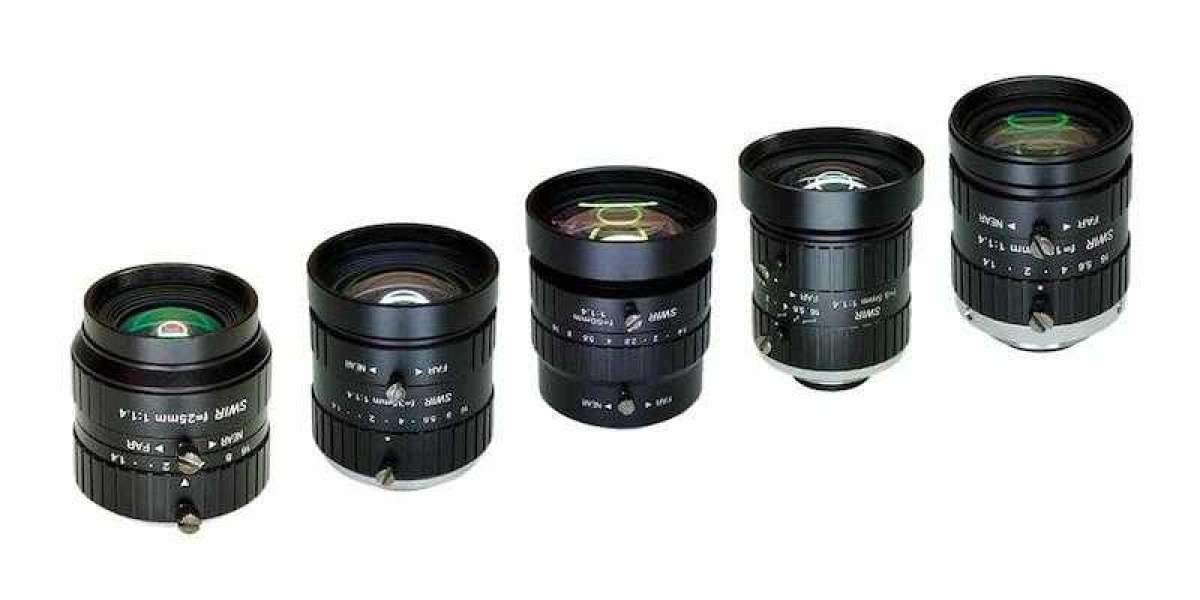

In today’s world, capturing clear and precise images at long distances has become crucial for many industries. Whether it’s security, surveillance, industrial inspection, or scientific research, the ability to see fine details from far away can make a significant difference. This is where the Swir Fixed Focal Length Lens plays an important role. Designed for shortwave infrared (SWIR) imaging, these lenses provide exceptional clarity, reliability, and performance, making them the go-to choice for applications that demand long-range imaging.
Understanding SWIR Technology
SWIR stands for Shortwave Infrared. Unlike visible light cameras, which capture images in the range of human vision, SWIR cameras detect wavelengths typically between 0.9 to 1.7 microns. This capability allows them to see through conditions that would obscure visible light, such as fog, smoke, dust, or haze. By pairing a SWIR sensor with a SWIR Fixed Focal Length Lens, operators can capture high-quality images with remarkable detail, even in challenging environments.
SWIR imaging is especially useful in industries where standard cameras may fail. For instance, in chemical manufacturing or semiconductor inspection, small defects can be easily detected with SWIR lenses. Similarly, in security and defense, they allow long-range surveillance in low-light conditions, improving safety and monitoring effectiveness.
Why Fixed Focal Length Matters
The term “fixed focal length” refers to a lens that has a set focal length, meaning it does not zoom in or out. While zoom lenses offer flexibility, they often compromise on sharpness, light efficiency, and image quality. On the other hand, a Swir Fixed Focal Length Lens provides superior optical performance because it is designed specifically for one focal length.
This fixed design ensures high-resolution imaging with minimal distortion. It is also easier to calibrate for SWIR cameras, which often need precise alignment to capture accurate spectral data. In long-range imaging, every millimeter counts, and fixed focal length lenses consistently provide sharper, more detailed images over extended distances.
Applications in Industrial Inspection
One of the most common uses of the Swir Fixed Focal Length Lens is in industrial inspection. Factories and production lines increasingly rely on automated systems to check products for defects. These lenses allow cameras to detect minute irregularities in materials such as metals, plastics, and semiconductors.
For example, in semiconductor production, small cracks or impurities can compromise an entire batch. SWIR lenses capture these imperfections without requiring high-intensity lighting, which could damage sensitive components. Similarly, in food inspection, SWIR imaging can detect moisture content, foreign objects, or surface defects that are invisible to conventional cameras.
By using a fixed focal length lens, industries benefit from consistent and repeatable inspection results. The lens ensures that every image taken is clear, sharp, and reliable, which is critical when precision is a top priority.
Security and Surveillance Advantages
Security is another area where Swir Fixed Focal Length Lenses shine. Traditional cameras often struggle in low-light or adverse weather conditions, making long-range surveillance difficult. SWIR cameras combined with fixed focal length lenses allow for clear imaging over long distances, day or night.
Military and defense applications particularly benefit from SWIR lenses. They can detect and identify objects hidden behind camouflage, through smoke, or in the dark. Even civilian security systems, such as border monitoring or critical infrastructure surveillance, can leverage these lenses to improve safety and response times.
The advantage of a fixed focal length lens in security applications lies in its consistency. Operators know exactly how far and wide their field of view is, making monitoring more predictable and reducing the chance of missing critical events.
Enhanced Imaging in Scientific Research
Scientific research also benefits greatly from Swir Fixed Focal Length Lenses. These lenses are used in spectroscopy, astronomy, and environmental monitoring. Scientists studying materials or observing distant objects require precise imaging and accurate spectral data. SWIR lenses provide both, offering clarity and sensitivity that visible-light lenses cannot match.
For instance, in environmental monitoring, SWIR lenses help detect moisture content in soil, track vegetation health, or monitor water quality. In astronomy, they allow telescopes to observe celestial bodies that emit infrared light, revealing details invisible in visible light.
Technical Advantages of Swir Fixed Focal Length Lenses
Several technical benefits make these lenses ideal for long-range imaging:
High Optical Quality: Fixed focal length lenses are optimized for clarity, sharpness, and minimal distortion.
Precision Alignment: SWIR imaging requires exact sensor alignment, which is easier with a fixed lens.
Low Light Performance: These lenses work effectively in low-light conditions without additional illumination.
Durability: SWIR lenses are often designed to withstand harsh industrial environments.
Consistent Field of View: Operators can rely on predictable imaging, crucial for security and inspection tasks.
These features combine to make the Swir Fixed Focal Length Lens a reliable choice for applications that demand high precision, long-range visibility, and consistent performance.
Choosing the Right Lens
Selecting the right Swir Fixed Focal Length Lens depends on several factors:
Focal Length: Determines the field of view and working distance. Longer focal lengths are suitable for distant objects, while shorter focal lengths cover wider areas.
Aperture Size: A larger aperture allows more light, improving performance in low-light conditions.
Material and Coatings: High-quality optical materials and anti-reflective coatings enhance image clarity and reduce distortions.
Environmental Tolerance: Lenses must withstand temperature changes, humidity, and industrial contaminants if used outdoors or in harsh conditions.
Consulting with manufacturers or experienced imaging professionals can help ensure that the lens meets the specific long-range imaging requirements of your project.
Future Trends and Developments
The demand for SWIR imaging and fixed focal length lenses is expected to grow in the coming years. As industries move toward automation and advanced monitoring, the need for precise long-range imaging will increase. Emerging technologies like AI-assisted image analysis, drone surveillance, and smart factory automation will integrate SWIR lenses to enhance performance.
Manufacturers are also developing lenses with improved light sensitivity, smaller sizes, and better spectral performance. These innovations make Swir Fixed Focal Length Lenses even more versatile, efficient, and suitable for a wider range of applications.
Conclusion
The Swir Fixed Focal Length Lens is a critical tool for anyone needing precise, long-range imaging. From industrial inspections to security surveillance and scientific research, these lenses provide unmatched clarity, reliability, and performance. Their fixed design ensures consistent imaging, high resolution, and minimal distortion, making them an ideal choice for applications where every detail matters.
Investing in a high-quality SWIR lens can significantly enhance imaging capabilities, allowing professionals to see what standard cameras cannot. With ongoing advancements in technology, these lenses will continue to play an essential role in industries and research fields that demand accuracy, durability, and performance over long distances.