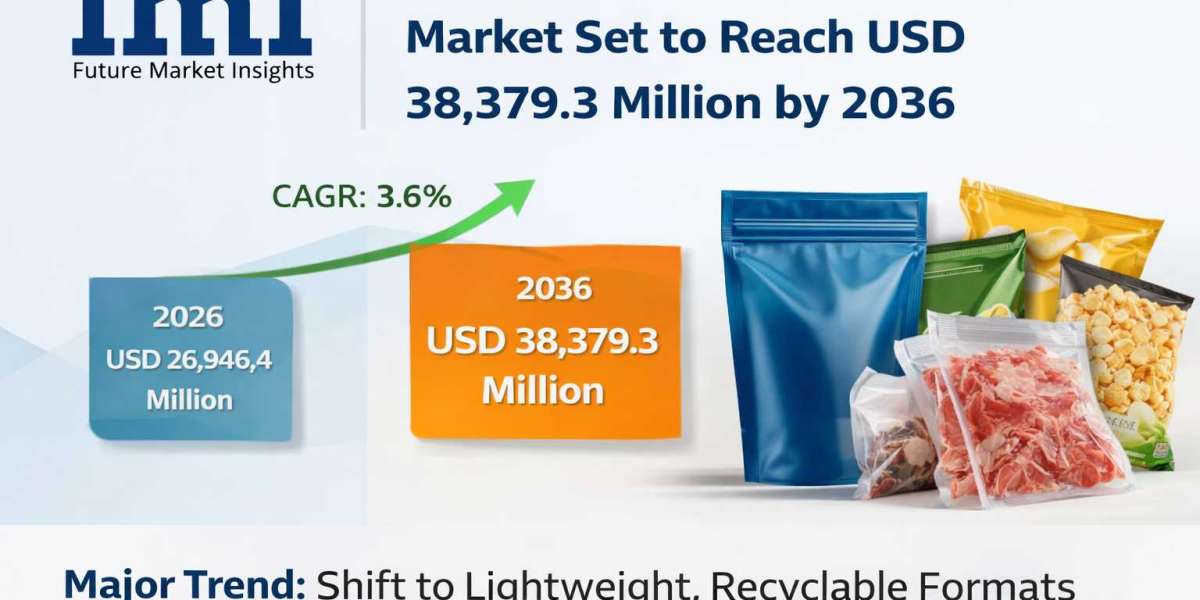

The USA flexible plastic packaging market is projected to witness steady structural expansion over the next decade as manufacturers shift from rigid packaging formats toward lightweight and high-performance flexible solutions. The market is estimated to reach USD 26,946.4 million in 2026 and is forecast to expand to USD 38,379.3 million by 2036, reflecting a compound annual growth rate (CAGR) of 3.6% during the forecast period.
Quick Stats: USA Flexible Plastic Packaging Market (2026–2036)
- Market Value (2026): USD 26,946.4 Million
• Forecast Value (2036): USD 38,379.3 Million
• CAGR: 3.6%
• Leading Segment: Modified Atmosphere Packaging (MAP) – 48.8% Share
• Key Product Segment: Films Wraps – 34.8% Share
• Fastest-Growing Countries: United States, Canada, Germany, China, India
• Key Growth Driver: Rapid substitution of rigid packaging with flexible recyclable formats
Structural Growth Driver: Rigid-to-Flexible Packaging Substitution
One of the primary structural growth drivers for the USA flexible plastic packaging industry is the gradual shift from rigid packaging formats such as glass containers, metal cans, and corrugated boxes toward flexible solutions. Flexible packaging offers advantages in terms of material efficiency, reduced logistics costs, and improved shelf-life performance for packaged goods. These benefits are particularly significant in food and healthcare sectors where product freshness and supply chain efficiency are critical.
Regulatory developments are also shaping industry expansion. State-level Extended Producer Responsibility (EPR) regulations in California, Oregon, Colorado, and Maine are introducing binding recyclability mandates and recycled content targets for plastic packaging. These frameworks require manufacturers and brand owners to redesign packaging materials to meet recyclability standards, thereby accelerating the adoption of mono-material flexible structures.
Furthermore, food safety standards and sustainability requirements are encouraging brand owners to prioritize flexible packaging technologies capable of maintaining barrier integrity while supporting recycling infrastructure development.
Key regulatory and industry frameworks influencing the market include:
- Extended Producer Responsibility (EPR) regulations
• Recycling and recycled content mandates
• Material sustainability and circular economy guidelines
• Food packaging safety standards
• Manufacturing and packaging compliance regulations
From Compliance to Industry Transformation
Flexible packaging manufacturers in the United States are transitioning from regulatory compliance toward broader industry transformation. Companies are increasingly investing in recyclable film structures, advanced barrier technologies, and improved packaging performance to meet both sustainability and product protection requirements.
At the same time, the supply chain is undergoing consolidation as large packaging companies expand their scale through mergers and acquisitions. Strategic investments in manufacturing capacity and advanced packaging technologies are enabling companies to deliver recyclable flexible formats while maintaining cost competitiveness against rigid alternatives.
Industry participants are increasingly prioritizing:
- Sustainability performance
• Cost efficiency and logistics optimization
• Recyclability and material circularity
• Compatibility with automated packaging lines
• Compliance with state-level regulatory mandates
Technology Transformation: Recyclable Flexible Film Innovation
Technological innovation is reshaping the flexible plastic packaging landscape in the United States. Manufacturers are investing in advanced material science to create mono-material recyclable films that maintain barrier properties while meeting recyclability guidelines.
Automation and advanced converting technologies are also improving manufacturing efficiency, enabling high-volume production of flexible laminates and packaging films. These innovations are particularly important for industries such as food packaging and e-commerce logistics where large production volumes and strict performance requirements are common.
Key innovation areas include:
- Advanced material development
• Automation integration in packaging lines
• Lightweight flexible packaging design
• Sustainable material engineering
• Manufacturing efficiency improvements
Segment Highlights
By Packaging Type
- Modified Atmosphere Packaging (MAP) – 48.8% Share: MAP systems dominate the market due to their ability to extend the shelf life of fresh food products such as poultry, seafood, and ready-to-eat meals.
• Vacuum Packaging – 21.4% Share: Widely used in meat and dairy applications to reduce oxidation and extend storage life.
• Retort Pouches – 14.6% Share: Increasingly used for shelf-stable foods and ready-to-eat meals due to convenience and extended preservation.
• Stand-Up Pouches – 9.3% Share: Popular in snack foods and consumer goods packaging due to strong shelf visibility and lightweight design.
• Other Flexible Packaging Formats – 5.9% Share: Includes sachets, flow wraps, and specialty packaging formats.
By Product Type
- Films and Wraps – 34.8% Share: The largest segment driven by demand in snack packaging, fresh produce, and frozen foods.
• Flexible Pouches – 26.5% Share: Increasingly adopted for ready-to-eat meals, beverages, and personal care products.
• Flexible Bags – 18.7% Share: Widely used in retail and industrial packaging applications.
• Stretch Films – 12.4% Share: Used extensively in logistics and pallet stabilization for transport.
• Bubble Mailers and Polybags – 7.6% Share: Growing demand from e-commerce packaging applications.
Regional Outlook: Emerging Economies Drive Adoption
Although the market scope is centered on the United States, global packaging supply chains and international brand strategies continue to influence industry development. Growth in food processing, e-commerce, and healthcare packaging sectors is expected to drive demand for flexible plastic packaging across multiple regions.
Country-level growth outlook includes:
- India (6.1% CAGR): Rapid expansion of food processing and retail packaging industries.
• China (5.4% CAGR): Strong demand from consumer goods and export-oriented packaging sectors.
• Brazil (4.7% CAGR): Increasing adoption in food and agricultural packaging.
• Germany (4.1% CAGR): Advanced packaging technology adoption and sustainability initiatives.
• United States (3.6% CAGR): Market expansion driven by rigid-to-flexible substitution and regulatory compliance requirements.
Risk Landscape: Market Constraints and Challenges
Despite steady demand growth, the flexible plastic packaging industry faces multiple operational and regulatory challenges that could impact long-term expansion.
Key challenges include:
- Raw material price volatility
• Supply chain disruptions in polymer resin supply
• Recycling infrastructure limitations
• Regulatory complexity across U.S. states
• High capital investment for recyclable packaging technologies
Competitive Landscape: Key Market Players
The competitive landscape of the USA flexible plastic packaging market is characterized by consolidation and strategic investment in recyclable packaging technologies. Leading companies are focusing on mergers, acquisitions, and capacity expansion to strengthen their market positions and comply with evolving regulatory requirements.
Top companies operating in the market include:
- Amcor Group GmbH
• Berry Global Group, Inc.
• Sealed Air Corporation
• Sonoco Products Company
• ProAmpac LLC
Other notable companies include Printpack Inc., Novolex Holdings Inc., C-P Flexible Packaging, American Packaging Corporation, Sigma Plastics Group Inc., Toppan Holdings, and Coveris Holdings.
Outlook: Future of the USA Flexible Plastic Packaging Market
The future of the USA flexible plastic packaging industry will be shaped by regulatory compliance, innovation in recyclable materials, and supply chain modernization. As brands prioritize sustainability and packaging efficiency, flexible plastic formats are expected to capture a larger share of the overall packaging market.
Key future growth drivers include:
- Technology advancement in recyclable films
• Sustainability and circular economy initiatives
• Manufacturing capacity expansion
• Supply chain innovation and logistics optimization
For an in-depth analysis of evolving industry trends and to access the complete strategic outlook for the market through 2036, visit the official report page at: https://www.futuremarketinsights.com/reports/united-states-flexible-plastic-packaging-market