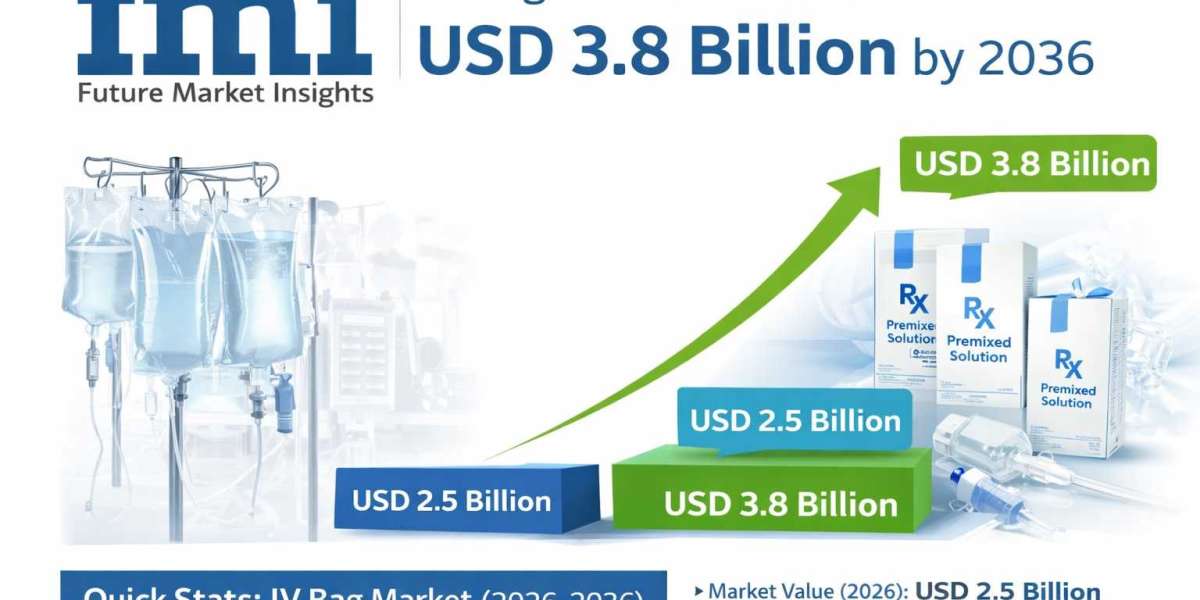

The global IV bag market is projected to reach USD 2.5 billion in 2026 and is expected to expand to USD 3.8 billion by 2036, registering a compound annual growth rate (CAGR) of 6.1% during the forecast period. Growth in the industry is largely attributed to the increasing global burden of chronic diseases requiring intravenous hydration, nutrition, and drug administration.
Quick Stats: IV Bag Market (2026–2036)
- Market Value (2026): USD 2.5 Billion
• Forecast Value (2036): USD 3.8 Billion
• CAGR: 6.1%
• Leading Segment: Single Chamber IV Bags (58% Share)
• Key Application Segment: Intravenous Therapies (60% Share)
• Fastest-Growing Countries: India, China, United States, Germany, Japan
• Key Growth Driver: Rising chronic disease prevalence and shift toward premixed drug IV solutions
Structural Growth Driver: Rising Chronic Diseases and Regulatory Push for Safer Medical Plastics
The increasing prevalence of chronic illnesses such as cancer, diabetes, kidney disorders, and severe infections is driving sustained demand for intravenous therapy worldwide. Hospitals rely heavily on IV bags for hydration therapy, drug delivery, and parenteral nutrition, making these medical consumables a critical component of modern healthcare systems.
Key regulatory and industry frameworks influencing the market include:
- EU Medical Device Regulation (MDR) compliance requirements
• US FDA safety guidelines for medical plastics
• Infection control and sterile packaging standards
• Hospital waste management regulations
• Sustainable medical plastic initiatives
From Compliance to Industry Transformation
The IV bag industry is evolving beyond simple fluid containers to become an integrated component of advanced drug delivery systems. Pharmaceutical companies and hospital networks are increasingly adopting ready-to-administer (RTA) IV bags containing premixed antibiotics, analgesics, and nutrition formulations.
Companies are prioritizing:
- Patient safety and medication accuracy
• Cost efficiency through optimized production lines
• Compatibility with smart infusion pumps
• Sterility and infection control features
• Sustainable material usage in medical packaging
Technology Transformation: Multi-Chamber Designs and Advanced Polymer Films
Technological innovation is rapidly transforming IV bag manufacturing. Companies are adopting multi-layer polymer films that provide superior barrier protection against oxygen and moisture, ensuring drug stability during storage.
At the same time, manufacturers are integrating multi-chamber designs that enable separate storage of incompatible drug components within the same container. Radio-frequency (RF) welding technologies are commonly used to create sealed compartments, though the shift toward polyolefin materials is pushing manufacturers to adopt alternative sealing techniques such as thermal contact welding and laser sealing.
Additional technological developments are enabling the integration of safety and tracking features into IV packaging systems.
Key innovation areas include:
- Advanced polymer film development for drug compatibility
• Multi-chamber IV bag engineering
• Automation integration in aseptic filling lines
• Lightweight medical packaging design
• Sterilization efficiency and manufacturing process optimization
Segment Highlights
By Chamber Type
- Single Chamber IV Bags (58% Share): Widely used for saline, dextrose, and electrolyte solutions in hospitals and emergency care.
• Multiple Chamber IV Bags: Designed for complex drug therapies and parenteral nutrition formulations requiring component separation.
By Application
- Intravenous Therapies (60% Share): Dominant segment due to widespread use in hydration, antibiotic therapy, and pain management.
• Parenteral Nutrition: Growing segment driven by rising critical care admissions and chronic disease management.
Regional Outlook: Emerging Healthcare Systems Drive Global Expansion
Global growth patterns in the IV bag market vary based on healthcare infrastructure development, chronic disease prevalence, and regulatory standards. Emerging economies are experiencing rapid demand growth due to expanding hospital infrastructure and rising healthcare spending.
Meanwhile, developed markets are focusing on higher-value innovations such as non-PVC materials and premixed therapeutic solutions.
Country-level growth projections include:
- India (7.2% CAGR): Expanding healthcare infrastructure and government initiatives supporting domestic medical manufacturing.
• China (7.0% CAGR): Rapid modernization of hospitals and aging population driving IV therapy demand.
• United States (5.0% CAGR): Strong demand for premixed drug solutions and advanced infusion therapies.
• Germany (4.6% CAGR): Early adoption of non-PVC medical plastics and strict regulatory standards.
• Japan (3.3% CAGR): Aging population increasing demand for home-based infusion therapy solutions.
Risk Landscape: Market Constraints and Challenges
Despite strong growth prospects, the IV bag industry faces operational challenges associated with production complexity, sterilization requirements, and raw material cost fluctuations.
Key market challenges include:
- Raw material price volatility for medical-grade polymers
• Sterilization bottlenecks for premixed drug formulations
• Supply chain dependency on specialized medical resins
• Regulatory compliance costs for medical device manufacturers
• High capital investment in aseptic filling technologies
Competitive Landscape: Key Market Players
The IV bag market is highly competitive, with major medical device companies investing heavily in advanced materials, manufacturing capacity, and strategic partnerships with pharmaceutical companies.
Leading players are expanding vertically integrated production capabilities—from polymer film extrusion to sterile filling—to ensure supply chain stability and maintain high product quality standards.
Top key companies include:
- Baxter
• B. Braun Medical
• ICU Medical, Inc.
• Fresenius Kabi Group
• Hospira
Other notable companies include Terumo Corporation, Wipak Group Management, Poly Medicure, Renolit, and Mountainside Medical Equipment.
Outlook: Future of the IV Bag Market
The future of the IV bag market will be defined by advancements in drug delivery systems, increasing demand for premixed therapeutic solutions, and rising adoption of safer medical plastics.
Healthcare providers are expected to continue prioritizing packaging solutions that improve patient safety, reduce clinical workload, and support advanced infusion therapies.
Key future growth drivers include:
- Technology advancement in polymer film engineering
• Sustainability initiatives in medical plastics
• Manufacturing expansion in emerging healthcare markets
• Supply chain innovation in sterile medical packaging
For an in-depth analysis of evolving industry trends and to access the complete strategic outlook for the market through 2036, visit the official report page at: https://www.futuremarketinsights.com/reports/iv-bag-market