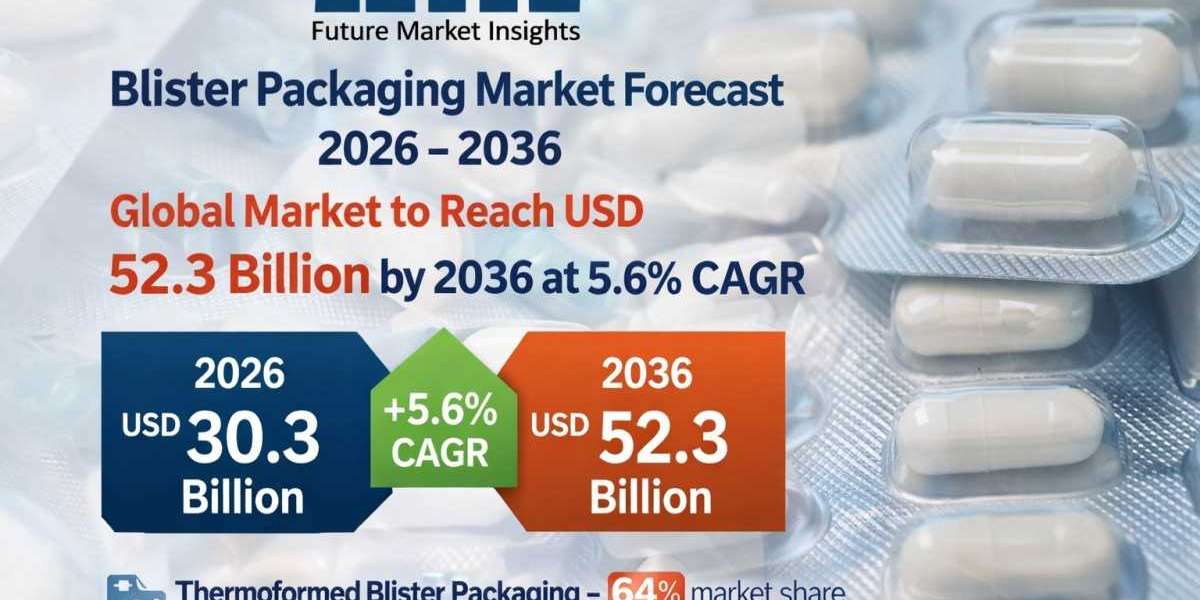

The global blister packaging market is projected to reach a valuation of USD 30.3 billion in 2026 and is expected to expand to USD 52.3 billion by 2036, registering a CAGR of 5.6% during the forecast period. Market growth is increasingly shaped by regulatory compliance requirements, particularly in pharmaceutical packaging where traceability, serialization, and safety protocols are becoming mandatory across global supply chains.
Quick Stats: Blister Packaging Market (2026–2036)
- Market Value (2026): USD 30.3 Billion
• Forecast Value (2036): USD 52.3 Billion
• CAGR: 5.6%
• Leading Segment: Thermoformed Blister Packaging (64.0% share)
• Key Application Segment: Pharmaceuticals (52.0% share)
• Fastest-Growing Countries: India, China, United States, Germany, United Kingdom
• Key Growth Driver: Pharmaceutical traceability regulations and circular packaging compliance
Structural Growth Driver: Pharmaceutical Traceability and Compliance Digitization
Regulatory frameworks for pharmaceutical traceability are becoming a structural driver for blister packaging adoption. Healthcare authorities are mandating package-level serialization and electronic verification systems, transforming packaging into an integral component of pharmaceutical supply chain security. Regulations such as the U.S. Drug Supply Chain Security Act (DSCSA) and traceability programs in Asia require packaging formats capable of maintaining machine-readable identifiers throughout manufacturing, distribution, and dispensing processes.
Key regulatory and policy influences include:
- Pharmaceutical traceability regulations and serialization mandates
• Recycling and packaging waste regulations
• Extended Producer Responsibility (EPR) compliance frameworks
• Packaging sustainability and recyclability guidelines
• GMP standards for pharmaceutical packaging materials
From Compliance to Industry Transformation
The blister packaging industry is transitioning from simple protective packaging toward compliance-driven and technology-enabled packaging systems. Pharmaceutical manufacturers now require packaging partners capable of delivering consistent printing quality, verification-ready packaging surfaces, and audit-ready documentation for regulated supply chains.
Companies increasingly prioritize:
- Sustainability performance and recyclability
• Cost-efficient high-speed packaging operations
• Regulatory compliance and traceability readiness
• Supply chain compatibility and automation integration
Technology Transformation: Recyclable Films and Smart Packaging Integration
Technological innovation is playing a crucial role in reshaping the blister packaging landscape. Film manufacturers and packaging converters are investing in advanced recyclable blister materials, high-barrier films, and improved thermoforming technologies that maintain pharmaceutical-grade protection while supporting circular economy objectives.
Automation and digital verification systems are also transforming packaging lines. Advanced vision inspection technologies, serialization printers, and verification software ensure consistent code readability and traceability compliance even under high-speed production conditions. These technologies allow pharmaceutical companies to maintain packaging integrity while meeting strict regulatory documentation requirements.
Key innovation areas include:
- Advanced recyclable film development
• Automation integration for packaging inspection
• Lightweight blister packaging structures
• Sustainable polymer and aluminum alternatives
• Manufacturing efficiency improvements
Segment Highlights
By Product Type
- Thermoformed Blister Packaging (64.0% share): Widely used due to high-speed production compatibility and material availability for pharmaceutical packaging.
• Cold-Form Blister Packaging: Preferred for products requiring high barrier protection against moisture and oxygen.
• Hybrid Blister Systems: Combining different materials for enhanced product protection and sustainability goals.
• High-Barrier Blister Films: Increasingly adopted in regulated healthcare applications.
• Recyclable Blister Formats: Emerging solutions designed to meet circular packaging regulations.
By Application
- Pharmaceuticals (52.0% share): Dominates due to serialization, patient safety, and traceability compliance requirements.
• Medical Devices: Blister packaging ensures sterility and tamper resistance for medical components.
• Consumer Healthcare: Used for over-the-counter medicines and healthcare products.
• Food Confectionery: Increasing adoption for portion control and product visibility.
• Electronics: Protects small components and accessories in retail packaging.
Regional Outlook: Emerging Economies Drive Adoption
The global blister packaging market is witnessing strong growth across both developed and emerging economies as pharmaceutical manufacturing expands and packaging regulations tighten. Asia-Pacific is emerging as a key growth hub due to regulatory modernization, rising pharmaceutical production, and increasing adoption of traceability systems.
Country growth projections include:
- India (7.1% CAGR): Driven by barcode and QR code compliance requirements for pharmaceutical packaging.
• China (6.6% CAGR): Supported by reimbursement-linked drug traceability systems and packaging compliance policies.
• United States (6.0% CAGR): Growth fueled by DSCSA traceability implementation and packaging automation investments.
• Germany (5.6% CAGR): Sustainability regulations and recyclability standards are influencing blister redesign.
• United Kingdom (5.4% CAGR): Plastic packaging taxes and EPR reporting requirements are shaping material selection.
Risk Landscape: Market Constraints and Challenges
Despite favorable growth prospects, the blister packaging industry faces several operational and regulatory challenges that could affect market expansion. Material complexity, evolving sustainability standards, and cost pressures may influence packaging innovation and adoption.
Key challenges include:
- Raw material price volatility
• Supply chain disruptions
• Recycling infrastructure limitations
• Regulatory compliance complexity
• High manufacturing and material costs
Competitive Landscape: Key Market Players
The blister packaging market is characterized by strong competition among global packaging manufacturers focusing on sustainability innovation, traceability compliance, and advanced packaging materials. Companies are investing in recyclable blister systems, circular polymer technologies, and automation-ready packaging formats to strengthen their market presence.
Top key companies include:
- Amcor plc
• Constantia Flexibles
• Klöckner Pentaplast
• Tekni-Plex Inc.
• Bilcare Limited
Other notable companies include Honeywell International Inc., Sonoco Products Company, WestRock Company, Winpak Ltd., and Bemis Company Inc.
Outlook: Future of the Blister Packaging Market
The future of the blister packaging market will be shaped by increasing regulatory scrutiny, digital traceability adoption, and sustainable material innovation. Pharmaceutical supply chains are expected to continue integrating packaging with digital verification systems, driving demand for packaging formats capable of supporting serialization and inspection technologies.
Key future growth drivers include:
- Technology advancement in packaging materials
• Sustainability and circular economy initiatives
• Expansion of pharmaceutical manufacturing
• Supply chain traceability and automation innovation
For an in-depth analysis of evolving industry trends and to access the complete strategic outlook for the market through 2036, visit the official report page at: https://www.futuremarketinsights.com/reports/blister-packaging-market