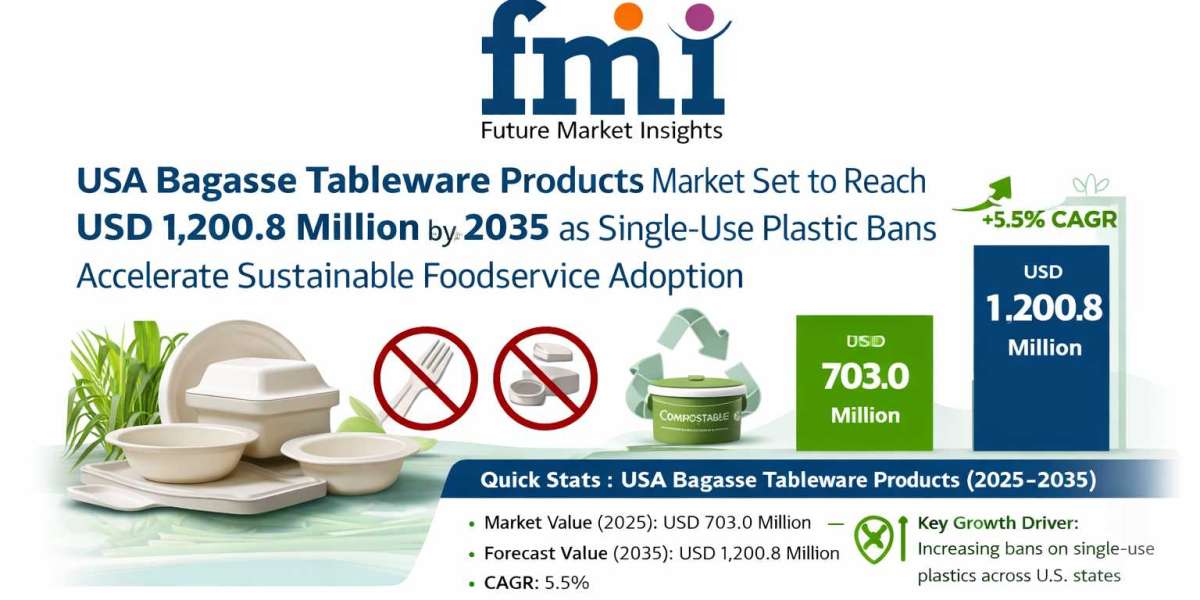

The USA bagasse tableware products market is experiencing steady growth as foodservice operators increasingly shift toward biodegradable and compostable alternatives to conventional plastic and foam tableware. The market is expected to reach USD 703.0 million in 2025 and is projected to expand to USD 1,200.8 million by 2035, reflecting a compound annual growth rate (CAGR) of 5.5% during the forecast period.
Quick Stats: USA Bagasse Tableware Products Market (2025–2035)
- Market Value (2025): USD 703.0 Million
• Forecast Value (2035): USD 1,200.8 Million
• CAGR: 5.5%
• Leading Segment: Commercial End-Use (Approx. 59% Share)
• Key Product Segment: Plates (Approx. 78.4% Share by 2035)
• Fastest-Growing Regions: West Coast, Northeast, Midwest, Southeast, Southwest
• Key Growth Driver: Increasing bans on single-use plastics across U.S. states
Structural Growth Driver: Government Plastic Bans and Zero-Waste Initiatives
Government policies and environmental regulations are a major structural force driving the growth of the bagasse tableware products market in the United States. Many states and municipalities are implementing restrictions on single-use plastics and expanded waste management regulations, encouraging businesses to adopt biodegradable and compostable packaging alternatives.
Bagasse tableware products offer a sustainable alternative to traditional plastic and foam food containers. Since they are derived from sugarcane fiber, these products naturally decompose under composting conditions without releasing harmful residues. As a result, foodservice providers increasingly rely on bagasse tableware to meet sustainability requirements while maintaining operational efficiency.
Key regulatory and industry frameworks supporting market adoption include:
- State-level bans on single-use plastics and foam containers
• Municipal zero-waste policies and composting programs
• Compostable packaging certification standards
• Sustainable foodservice packaging guidelines
From Compliance to Industry Transformation
The adoption of bagasse tableware products is evolving beyond regulatory compliance toward a broader industry transformation in sustainable foodservice packaging. Restaurants, food trucks, catering companies, and quick-service restaurant chains are integrating compostable packaging into their operational strategies to align with consumer expectations and sustainability commitments.
Businesses increasingly view sustainable packaging not only as an environmental requirement but also as a competitive advantage. Many foodservice providers highlight compostable packaging as part of their brand identity, appealing to environmentally conscious consumers.
This transformation is also supported by the expansion of online food delivery and takeout services, which require durable and leak-resistant packaging solutions. Bagasse products provide strong structural integrity, heat resistance, and compatibility with a wide variety of food items, making them suitable for modern foodservice logistics.
Key priorities shaping industry transformation include:
- Sustainability performance in foodservice packaging
• Cost-efficient biodegradable product alternatives
• Compostability and waste reduction compliance
• Operational compatibility with food delivery systems
• Consumer perception and brand differentiation
Technology Transformation: Sustainable Fiber-Based Packaging Innovation
Technological advancements in fiber molding and biodegradable material engineering are improving the performance and scalability of bagasse tableware products. Manufacturers are developing advanced molded fiber technologies that enhance product strength, leak resistance, and heat tolerance.
Innovations in production technology are also enabling manufacturers to produce lightweight yet durable tableware products while reducing material waste and energy consumption during manufacturing processes.
Additionally, improvements in material treatment and surface finishing technologies allow bagasse tableware to maintain structural integrity when used with hot or greasy food items, expanding its applications across foodservice sectors.
Key innovation areas include:
- Advanced molded fiber material development
• Automation in biodegradable tableware manufacturing
• Lightweight and durable fiber product designs
• Sustainable raw material engineering
• Manufacturing efficiency improvements
Segment Highlights
By Product Type
- Plates (78.4% share by 2035): Widely used in restaurants, catering events, and takeout services due to durability and versatility.
• Bowls (26% share): Highly adopted for soups, salads, and prepared meals due to leak-proof structure.
• Containers and Clamshells: Increasingly used for takeout and delivery packaging.
• Cups and Drink Carriers: Used for beverages and takeaway drinks in cafes and restaurants.
• Cutlery and Trays: Emerging segment driven by zero-waste dining initiatives.
By Application / End-Use
- Food Applications (75.2% share by 2035): Dominates due to strong demand from restaurants and takeout services.
• Beverage Applications: Used for coffee cups and drink containers in cafes.
• Commercial Use (59% share): Includes restaurants, catering services, and food delivery operators.
• Institutional Use: Includes schools, hospitals, and corporate cafeterias.
• Household Use: Growing adoption among environmentally conscious consumers.
Regional Outlook: Sustainable Packaging Adoption Across U.S. Regions
Adoption of bagasse tableware products across the United States varies by region depending on local regulations, sustainability initiatives, and foodservice industry size. Regions with strict environmental regulations and strong composting infrastructure are leading market growth.
Regional growth trends include:
- West Coast (6.2% CAGR): Strong sustainability regulations and zero-waste initiatives.
• Northeast (5.8% CAGR): High adoption among restaurants and catering services.
• Midwest (5.4% CAGR): Growing food delivery industry driving demand.
• Southeast (5.1% CAGR): Expansion of quick-service restaurant chains.
• Southwest (5.0% CAGR): Increasing municipal sustainability programs.
Risk Landscape: Market Constraints and Challenges
Despite steady market growth, several factors may limit the expansion of bagasse tableware products in the U.S. market.
Key challenges include:
- Competition from PLA and recycled paper packaging alternatives
• Price sensitivity among foodservice operators
• Supply chain constraints for sugarcane fiber raw materials
• Limited composting infrastructure in certain regions
• Production cost fluctuations
Competitive Landscape: Key Market Players
The USA bagasse tableware products market is characterized by a mix of global packaging manufacturers and regional suppliers focusing on sustainable fiber-based packaging solutions. Leading companies are expanding product portfolios, investing in new product development, and forming partnerships with foodservice operators to strengthen market presence.
Top key companies include:
- Vegware Ltd
• Genpak
• Dart Container Corporation
• Duni Global
• Material Motion, Inc.
Other notable companies include Detpak (Detmold Group), Sabert Corporation, Natural Tableware, Karat Earth, and BioGreenChoice.
Outlook: Future of the USA Bagasse Tableware Products Market
The future of the USA bagasse tableware products market will be shaped by increasing environmental regulations, consumer demand for compostable packaging, and expansion of sustainable foodservice practices. As companies invest in advanced fiber-based packaging technologies and supply chain innovations, bagasse tableware products are expected to become a mainstream solution across the foodservice industry.
Future growth drivers include:
- Technology advancement in molded fiber packaging
• Sustainability initiatives in foodservice industries
• Manufacturing expansion for biodegradable packaging
• Supply chain innovation and material sourcing improvements
For an in-depth analysis of evolving industry trends and to access the complete strategic outlook for the market through 2035, visit the official report page at: https://www.futuremarketinsights.com/reports/usa-bagasse-tableware-products-market